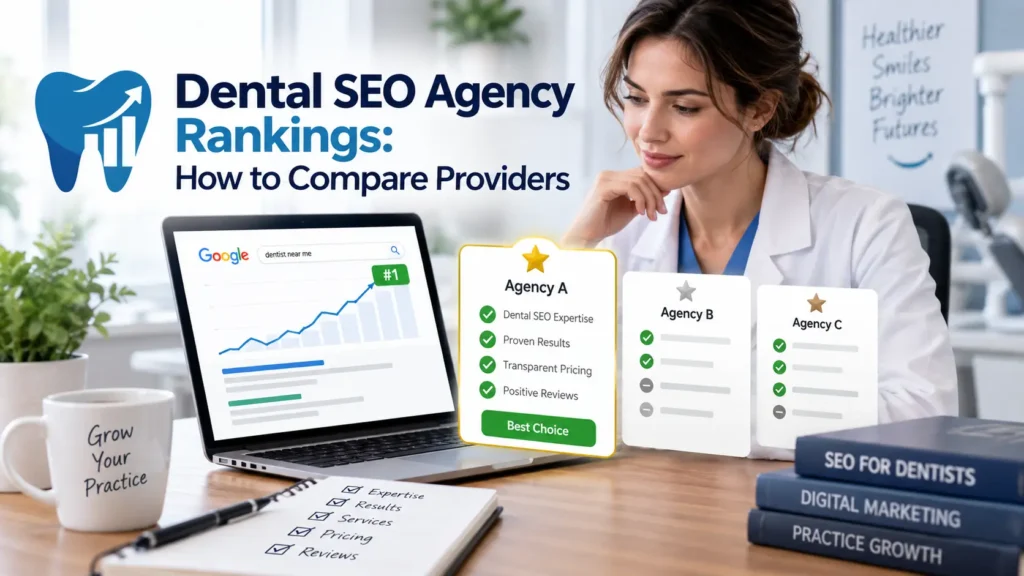
Search top dental SEO agencies and you will find a dozen ranked lists. Different lists, different winners, almost no overlap between them.
That is not because the industry is hard to assess. It is because most of those lists are sold, not earned. Before you use any ranking to shortlist a provider, it is worth understanding what the ranking actually measures and then replacing it with something that measures what matters to your practice.
This guide gives you a scoring framework you can apply to any provider, the questions that separate operators from salespeople, and the answers that should end a conversation early.
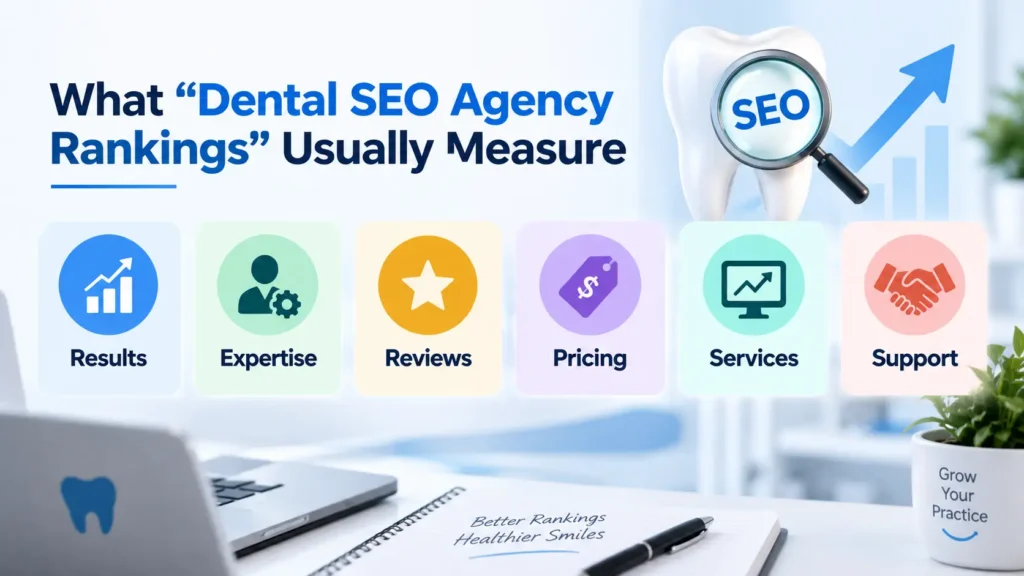
What “Dental SEO Agency Rankings” Usually Measure
Almost never results.
The typical ranked list scores agencies on things that are easy to collect and impossible to verify: years in business, self-reported team size, a stated minimum project budget, and a handful of reviews the agency solicited from its own clients. None of that tells you whether a single-location practice in your city added patients.
What it does tell you is that the agency knew the list existed and was willing to participate. That is a marketing signal, not a performance one.
The Three Kinds of Ranking Lists
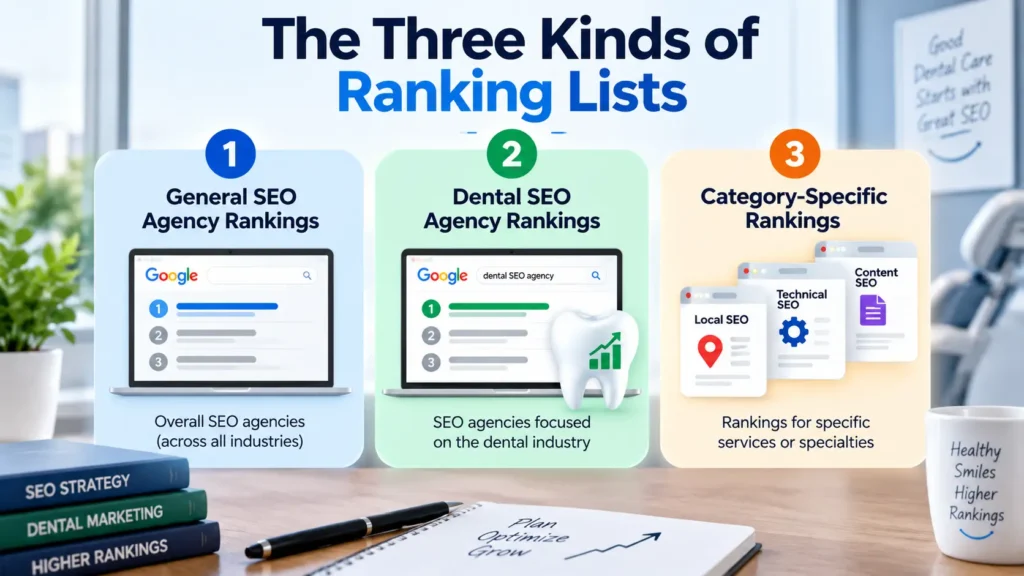
Paid B2B directories
Platforms like the major agency directories operate on a listing model. Agencies pay for placement, sponsored positions, or premium profiles. The reviews on them are usually genuine, but they are collected by the agency from clients it selected — so you are reading a curated sample, not a representative one.
Use them for: finding candidates and reading review detail. Do not use them for: ranking order. That is inventory.
Affiliate and lead-generation roundups
The “10 Best Dental SEO Companies of 2026” blog posts are frequently written by companies that either sell leads to the agencies listed, take a referral fee, or are themselves agency number one on their own list. Check the footer and the disclosure. Check whether the site sells anything else.
Use them for: discovering names you had not heard. Do not use them for: anything else.
Peer recommendations from other practice owners
The most reliable source available to you, and the least structured. Dental study clubs, state association meetings, private practice-owner groups, your CE cohort. A colleague with a comparable practice in a non-competing market will tell you things no directory ever will — including what the reporting was really like month six.
Use them for: shortlist and reality-check. Limitation: sample size of one, and their market is not your market.
Replace the Ranking With a Scorecard
A ranking sorts agencies by criteria someone else chose. A scorecard sorts them by criteria that matter to you. Take your three or four finalists and score each on the dimensions below.
Weight them yourself. A practice that lives on implant cases should weight content authorship heavily. A practice fighting for near-me volume should weight local search and reviews.
Comparison Point 1: Dental-Only or Generalist?
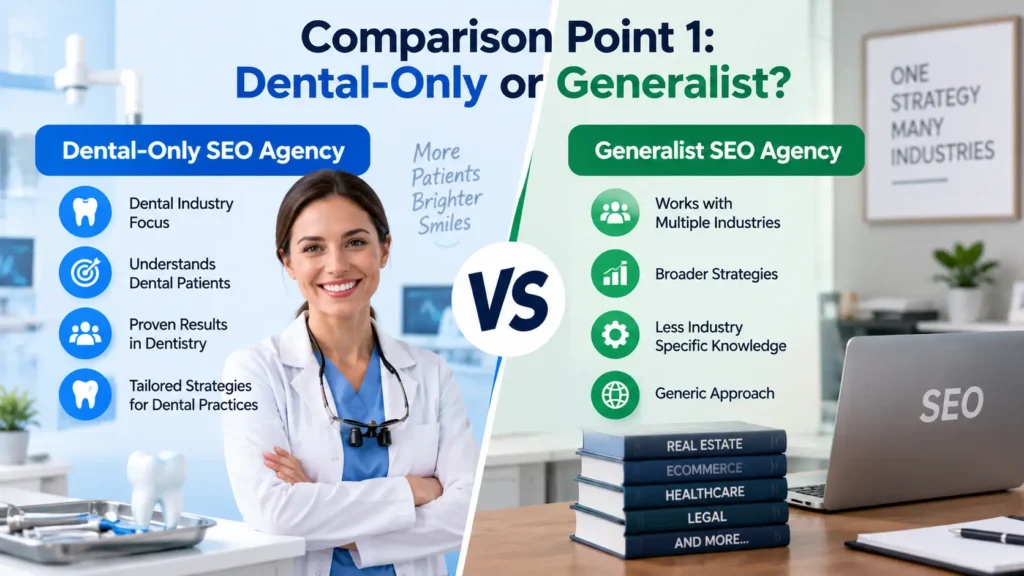
A generalist agency treats every conversion the same. In dentistry that is a costly error, because a hygiene appointment and a full-arch consultation differ in value by a factor of a hundred. An agency optimizing for total lead count will happily deliver you more of the wrong ones.
Ask: what percentage of your clients are dental practices, and how many are in my situation single location, owner-operated?
Strong answer: a specific number, plus a description of how their approach differs for high-value versus routine treatments. Weak answer: “we work across healthcare.”
Specialization is the entire premise of what we do we take no other industry but the point stands whoever you hire.
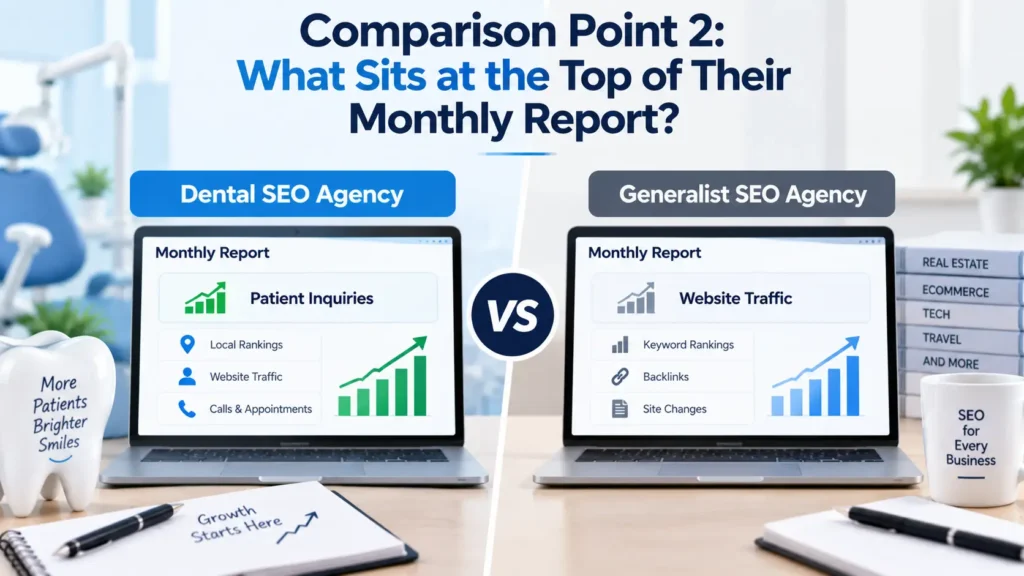
Comparison Point 2: What Sits at the Top of Their Monthly Report?
This is the single most revealing question in the whole comparison.
Ask each finalist to send you a sample monthly report with client details removed. Look only at what appears first.
If the first thing on page one is a keyword position chart, the agency is optimizing for something that looks like progress. If the first thing is new patients from search, calls answered versus missed, and the treatment mix those patients arrived for, the agency is optimizing for your schedule.
Ask: which number on this report would you expect me to care about most?
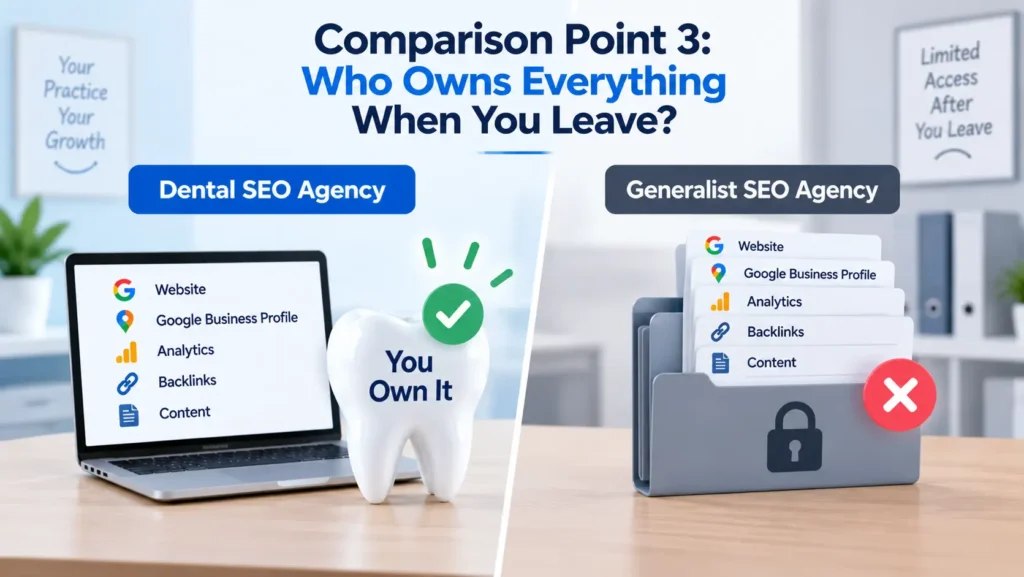
Comparison Point 3: Who Owns Everything When You Leave?
Agencies vary enormously here, and the difference only becomes visible on the day you cancel.
Some build your site on a proprietary platform you cannot export. Some register the domain in their own name. Some hold administrative ownership of your Google Business Profile, your call-tracking numbers, or your Google Ads account which means switching providers costs you your history.
Ask, in writing: at the end of this relationship, what do I keep, and what walks out the door with you?
Strong answer: you own the domain, the site, the content, the Business Profile, the analytics, and the tracking numbers, and they will transfer administrative access on request.
Comparison Point 4: Can They Show Verifiable Results?
Anonymous case studies are effectively unverifiable. “A dental client in the Southeast grew 340%” cannot be checked, and 340% of a very small number is a small number.
Ask for: two named practices in non-competing markets you can call directly.
An agency confident in its work will make that introduction. One that refuses is telling you something. Our own client results are published with practice names attached for exactly this reason.
Comparison Point 5: Who Writes the Content, and Who Reviews It?
Dental content is health content. Google applies a higher standard to pages that can affect a reader’s wellbeing or finances, and dental treatment pages are both.
Content produced by an unnamed writer working from a keyword list — or generated wholesale and published unedited — creates measurable risk for the domain. Content attributed to a named, credentialed dentist performs better and holds up through algorithm updates.
Ask: who writes it, does a dentist review it, and will my name and credentials appear on the page as the reviewer?
Follow up: what is your policy on AI-generated content, and what does a human do to it before publication?
Comparison Point 6: How Do They Handle Reviews?
Review strategy is where agencies get practices into regulatory trouble.
Incentivized reviews, filtered feedback funnels that only route happy patients to Google, and third-party review posting all violate platform policies and, in several cases, FTC rules that apply directly to you rather than to the agency.
Ask: exactly how do you generate reviews, and does anything you do involve incentives or gating?
Strong answer: automated request to every patient after every visit, no filtering, a separate private channel for complaints, and written responses to all reviews within a defined window.
Comparison Point 7: What Are the Contract Terms?
Twelve-month lock-ins exist because SEO takes time. They also exist because they protect the agency from the consequences of underperforming for six months.
There is a reasonable middle ground: a realistic timeline explained honestly, combined with the freedom to leave if the work stops.
Ask: what is the notice period, and what happens if I want out in month four?
How Pricing Models Compare
| Model | How it works | Best for | Watch for |
|---|---|---|---|
| Monthly retainer | Fixed fee, defined scope | Most single-location practices | Vague scope; ask what is guaranteed each month |
| Project fee | One-off build or fix | Sites needing a technical rebuild first | No ongoing work means rankings drift |
| Performance-based | Fee tied to leads or calls | Practices with capacity to fill | Definition of a “lead”; wrong-number calls counted |
| DSO-style bundle | Marketing bundled with other services | Groups | Rarely priced or scoped transparently for independents |
Price alone tells you little. A cheap retainer that produces three blog posts and no local search work is more expensive than a higher fee that fills chairs.
Nine Questions to Ask on Every Sales Call
- How many dental practices like mine do you currently work with?
- Which competitors of mine, if any, do you already work with?
- What will you do in month one, specifically?
- Who is my day-to-day contact, and are they in-house?
- What do you need from me each month, and how much of my time?
- How do you measure a new patient from search?
- What do you consider a realistic timeline for my most valuable treatment?
- What have you tried for a practice like mine that did not work?
- What do I own if I leave?
Question nine and question two are the ones that produce the most revealing pauses.
Red Flags That Should End the Conversation
- A guaranteed position on page one, in any timeframe
- Reluctance to name any current client
- Reporting that shows only rankings and traffic
- Pressure to sign before you have received a written scope
- A proposal that does not mention your Google Business Profile at all
- Content samples with no named author or clinical reviewer
- Any suggestion that reviews can be bought, gated or removed
- Cold outreach claiming they “noticed errors on your site” with no specifics
How to Run the Comparison in Two Weeks
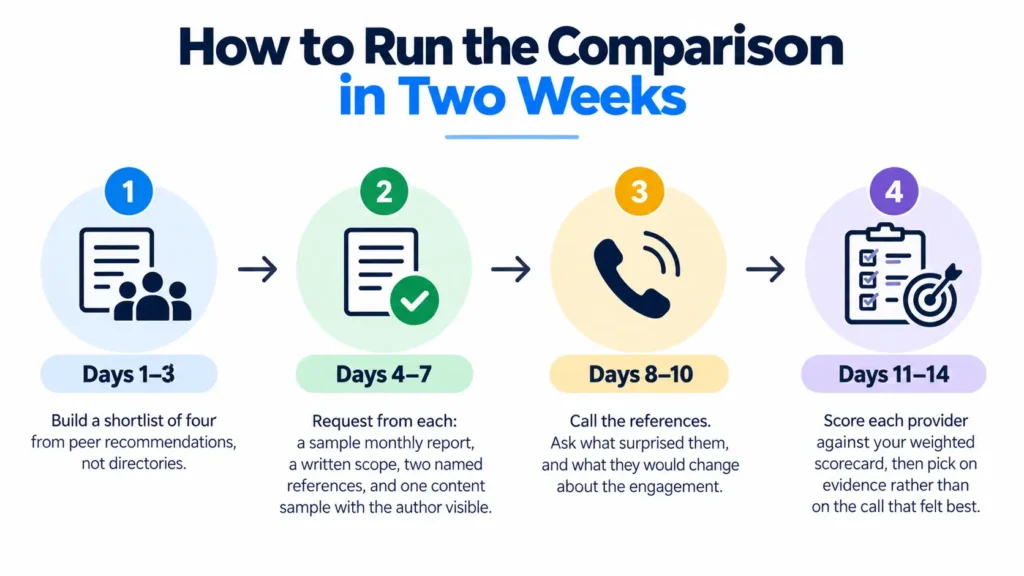
Days 1–3. Build a shortlist of four from peer recommendations, not directories.
Days 4–7. Request from each: a sample monthly report, a written scope, two named references, and one content sample with the author visible.
Days 8–10. Call the references. Ask what surprised them, and what they would change about the engagement.
Days 11–14. Score each provider against your weighted scorecard, then pick on evidence rather than on the call that felt best.
A Free Audit Beats a Sales Deck
The fastest way to compare providers is to make each one show their thinking on your practice before you pay anything.
Ours takes 48 hours and comes back as a recorded walkthrough: where you rank across each treatment you offer, how your Business Profile compares to the practices above you, the technical issues costing you visibility, and the first three things we would change. No obligation, and you keep the findings whoever you hire or read more about our approach first.
Related reading: Best Dental SEO Agency in Atlanta · Top Dental SEO Agency Serving LA County