“Dental company” covers five businesses that have almost nothing in common in search.
A single-location practice in Tucson, a fourteen-office group in the Midwest, a DSO acquiring two practices a quarter, a dental lab selling to dentists, and a software company selling practice-management tools all need SEO. They need almost entirely different SEO.
The agency that fills chairs for an owner-operator is often the wrong hire for a group with fourteen Google Business Profiles, and completely wrong for a B2B brand whose buyer is the dentist rather than the patient. Most bad agency fits in this industry come from that mismatch rather than from incompetence.
This guide sorts the capabilities by company type so you can shortlist against what you actually are.
The Five Types of Dental Company
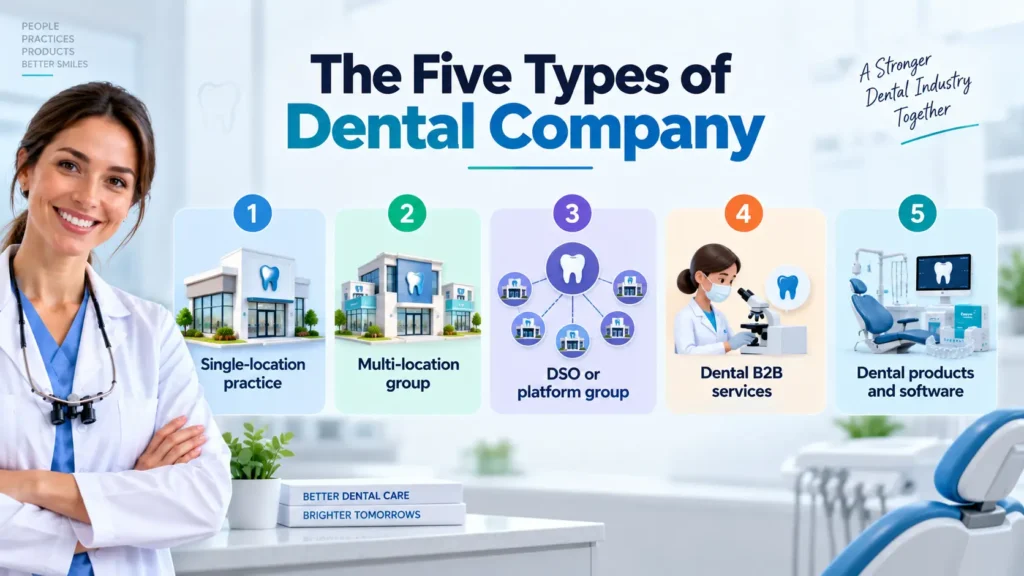
Single-location practice. One address, one profile, patient-facing. Success is booked appointments and the treatment mix behind them.
Multi-location group. Two to twenty offices under one brand. Success is per-location performance without the locations cannibalizing each other.
DSO or platform group. Twenty-plus offices, often multi-brand, frequently acquiring. Success is portfolio-wide visibility plus safe migrations when practices join.
Dental B2B services. Labs, billing companies, staffing, consulting. The buyer is a dentist or office manager, the sales cycle runs weeks to months, and the search volume is a fraction of patient-side volume.
Dental products and software. Equipment, materials, aligner brands, practice-management platforms. Often national or global, with distributor and reseller complexity layered on top.
Why an Agency That Fits One Rarely Fits Another
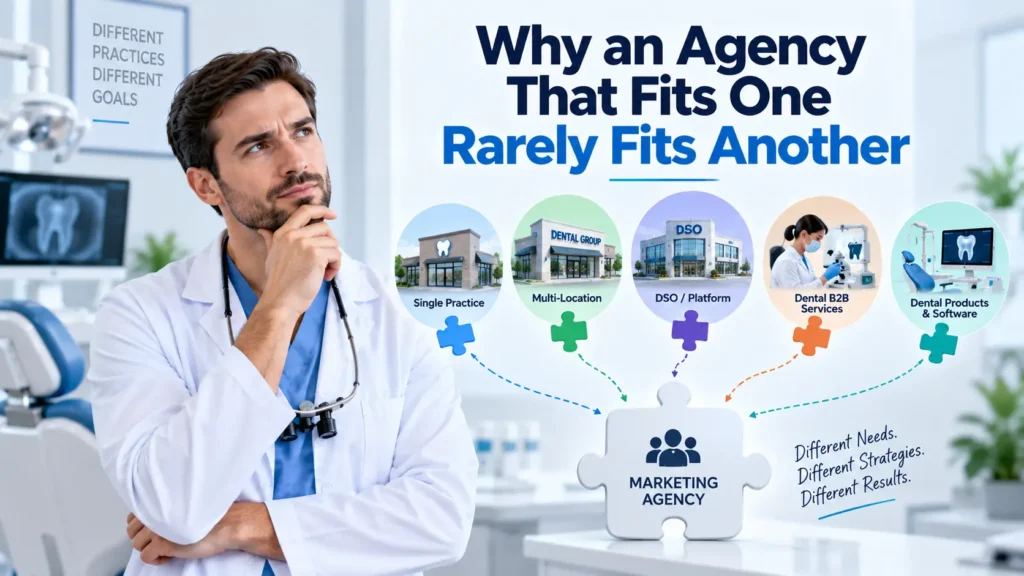
The skill sets diverge sharply.
Patient-side SEO is a local search discipline. It lives in Google Business Profile management, proximity, review velocity, and treatment pages written for someone in pain or comparing prices at 10pm.
B2B dental SEO is a demand-generation discipline. It lives in bottom-funnel comparison content, technical documentation, integration pages, pricing transparency, and attribution across a long consideration window. Nobody searches for a dental billing vendor at 10pm because a molar hurts.
An agency strong at one is not automatically weak at the other, but you should assume it until proven, and ask for evidence in your specific category.
What a Single-Location Practice Should Look For
For an owner-operated practice, almost all of the return comes from a narrow set of work: a fully built Google Business Profile, clean citations, fast mobile pages, treatment pages with real cost ranges, and a review system that runs without staff remembering to run it.
You do not need enterprise tooling. You need someone who understands that a full-arch case and a hygiene recall are not the same conversion, and who reports in patients rather than positions.
If that is your situation, our dental SEO services are built specifically around single-location practices rather than adapted down from enterprise work. If you want to learn more about our team and approach, visit our dental SEO agency.
What a Multi-Location Group Should Look For
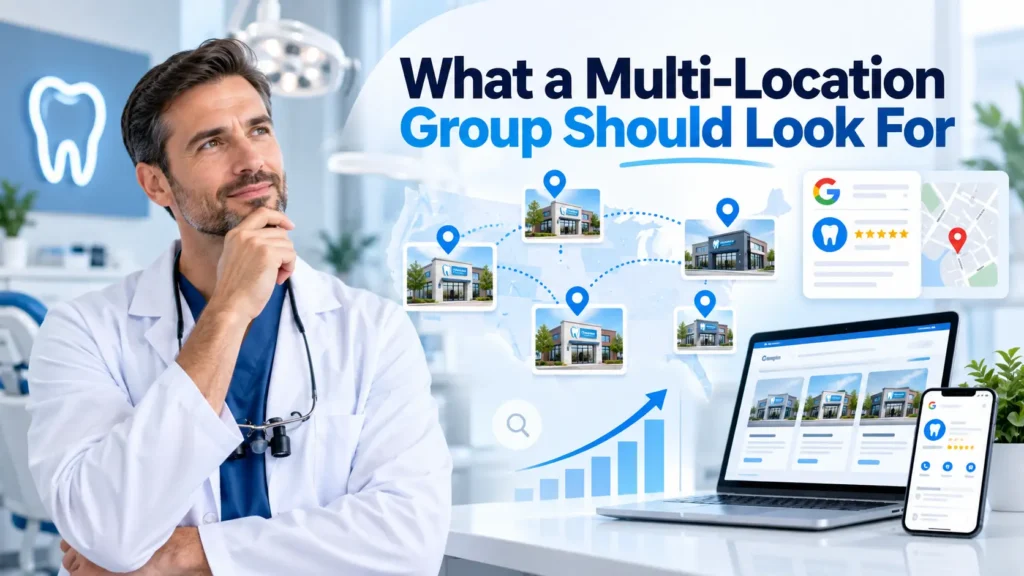
Groups face problems single practices never encounter.
Location page architecture. Fourteen near-identical location pages built from one template compete with each other and often get treated as thin content. Each needs genuinely distinct content — local detail, that office’s team, the treatments actually offered there, the neighbourhoods it draws from.
Profile management at scale. Fourteen Business Profiles means fourteen sets of categories, hours, photos, posts, questions and review streams. Without a defined process this decays within months, and decayed profiles are the most common cause of flat performance in group SEO.
Brand versus local queries. People searching your brand name are a different job than people searching dentist near me in one of your cities. Reporting that blends them hides which locations are underperforming.
Internal linking structure. Groups usually have the raw material for a strong site architecture and almost never use it. Treatment hubs linking down to location-specific treatment pages, and location pages linking up, is often the single highest-return technical change available.
Ask any agency pitching you how many locations the largest client they personally manage has. There is a real difference between five and fifty.
What a DSO or Platform Group Should Look For
At DSO scale, the risks change shape.
The expensive failure is not a slow month. It is a botched migration — a newly acquired practice rebranded and moved onto the platform site without redirect mapping, losing the local authority and reviews that made the acquisition worth making. That damage takes a year to undo.
Look for an agency that can describe its migration protocol in detail before you ask: profile ownership transfer, review continuity, redirect mapping, phased rebranding, and a hold period before consolidating anything.
Portfolio reporting matters just as much. If you cannot see which offices are gaining and which are sliding, you cannot allocate.
What a Dental B2B or Product Company Should Look For
If you sell to dentists rather than to patients, most of the dental SEO market is not built for you.
Your buyer researches in a completely different pattern: comparison searches against named competitors, integration and compatibility questions, pricing they expect to see published, and documentation they read before ever contacting sales. Volume is low and intent is high, which flips the content strategy — a page that gets forty visits a month can be worth more than one that gets four thousand.
You also need attribution that survives a sixty-day cycle across multiple sessions and devices. Agencies used to counting phone calls from patients often cannot build that.
Capability Comparison by Company Type
| Capability | Single practice | Multi-location group | DSO | Dental B2B |
|---|---|---|---|---|
| Google Business Profile depth | Critical | Critical, at scale | Critical, plus governance | Minor |
| Local citation cleanup | High | High | High | Low |
| Treatment page content | Critical | High | Medium | Not applicable |
| Location page architecture | Not applicable | Critical | Critical | Not applicable |
| Review systems | Critical | Critical | Critical, plus aggregation | Low |
| Migration and redirect protocol | Low | Medium | Critical | Medium |
| Comparison and pricing content | Medium | Medium | Low | Critical |
| Long-cycle attribution | Low | Medium | High | Critical |
| Portfolio-level reporting | Not applicable | High | Critical | Medium |
Use the column that matches you. An agency scoring well in the wrong column is not a good fit, however strong the case studies look.
What Every Dental Company Needs, Whatever the Size
Four things do not change across the five types.
Named clinical or subject-matter authorship, because dental content is health content and Google holds it to a higher standard than a page about garden furniture. Structured data appropriate to the entity type, so machines can read what the business is and what it offers. Genuine mobile performance rather than a passing score on a desktop test. And reporting that starts with revenue-adjacent outcomes instead of traffic.
An agency that treats all four as optional extras is selling content volume, not search performance.
In-House, Agency, or Hybrid
Below roughly five locations, an agency almost always wins on cost. There is not enough work to justify a full-time specialist salary, and a part-time generalist marketer will not have the local search depth.
Between five and twenty locations, hybrid tends to work best: someone in-house who owns profiles, reviews and photography day to day, with an agency handling technical work, content and strategy.
Above twenty, the question becomes which parts to keep in-house rather than whether to. Most groups at that size run an internal lead with agency support for content production and technical projects.
How to Brief an Agency Properly
Send the same brief to everyone you are considering, and make it specific. State your company type and location count. Name your highest-value treatments or products. List your top three competitors by name. State what you currently spend and on what. Say what you want to be true in twelve months in numbers rather than adjectives.
Vague briefs produce vague proposals, and vague proposals are impossible to compare against each other.
For a structured way to evaluate the replies, our guide to comparing dental SEO providers walks through a scorecard, the questions worth asking, and the answers that should end a conversation.
Signals You Hired the Right One
You know within about ninety days, well before rankings settle.
The reporting makes sense without explanation. The agency tells you what did not work before you ask. They push back on requests that would waste money instead of quietly billing for them. They ask your front desk questions, not just your marketing contact. And the specific work they promised in the proposal is visibly happening.
Practices we work with describe that experience in their own words on our results page.
Start With an Audit, Not a Proposal
Any agency worth hiring should be willing to show its thinking on your business before you pay.
Ours comes back inside 48 hours as a recorded walkthrough covering where you rank today, how your visibility compares to the competitors you named, the technical issues holding you back, and the first three changes we would make. It is free, there is no obligation, and the findings are yours whoever you end up hiring.
Request your free audit to get started.
If you would rather talk through fit for your company type first, contact the team and we will tell you honestly if you are better served elsewhere.
Also worth reading: Best Dental SEO Agency in Atlanta and Top Dental SEO Agency Serving LA County if you are evaluating providers in those markets.