“SEO” is a vague label for a set of jobs that don’t obviously belong together. A dental office SEO agency writes, codes, manages listings, chases links, and reads call recordings and most practice owners only ever see the invoice and the monthly report sitting on either end of it.
This is a breakdown of the actual work, organised by discipline rather than by timeline, so you can tell which parts your agency is doing and which parts are quietly being skipped.
The one-sentence version
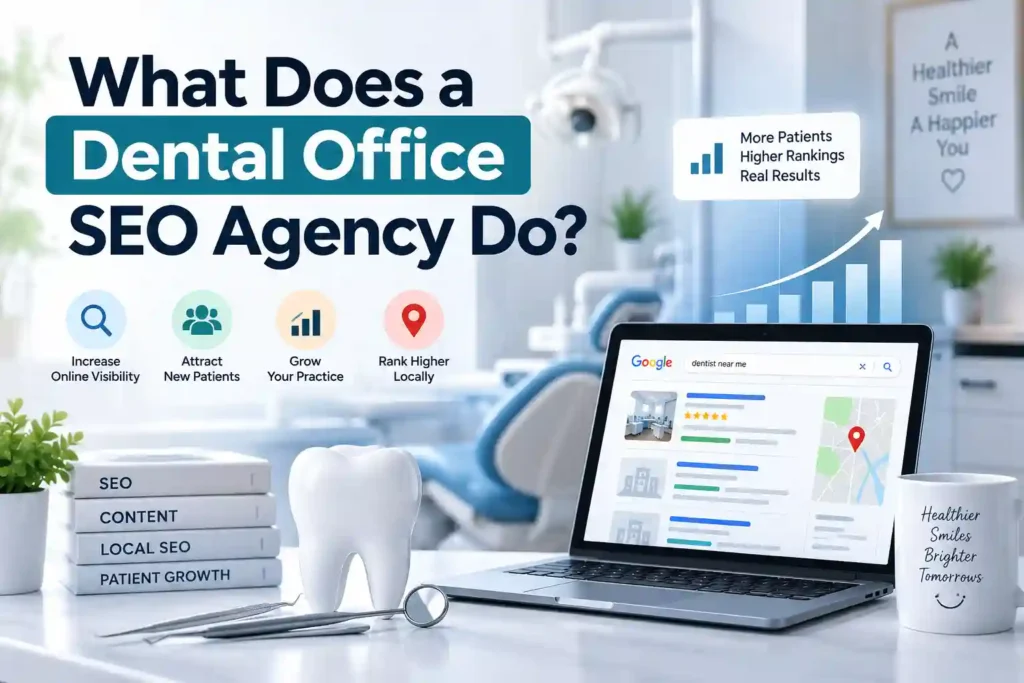
A dental office SEO agency makes your practice the obvious result when someone nearby searches for a dentist or a specific procedure, and then proves how many of those searches turned into booked appointments. Everything below serves one of those two goals.
Technical work: making the site legible to Google

Search engines have to crawl, understand, and trust your site before anything else matters. The technical workstream covers crawl errors and broken redirects, indexing rules, mobile usability, and Core Web Vitals mostly load speed, which on dental sites is usually killed by uncompressed hero images and a bloated page builder.
It also covers structured data. A dental office should carry Dentist and LocalBusiness schema at minimum, plus Service schema on procedure pages and FAQ schema where you answer common questions. This is how Google understands that you’re a practice in a specific place offering specific treatments, rather than a page that happens to mention teeth.
Internal linking sits here too, and it’s the most commonly neglected item on the list. Your implant page should be linked from relevant blog posts and from related service pages, not orphaned three clicks deep in a dropdown menu.
Local SEO: the Google Business Profile is the real front door
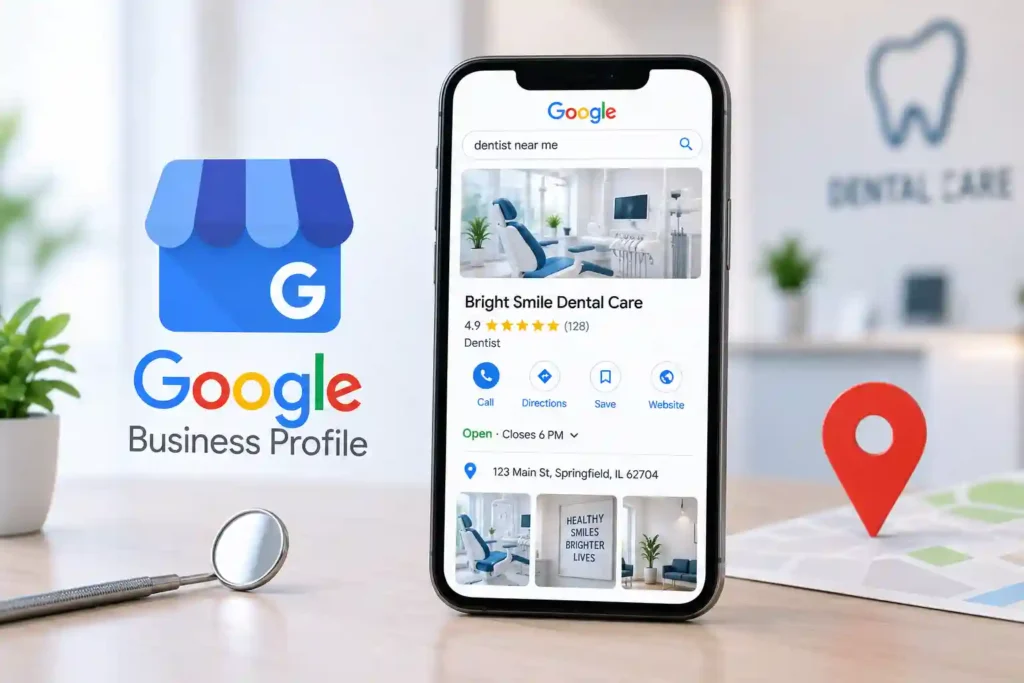
For most dental offices, the map pack produces more phone calls than the website does. Managing it properly is ongoing work, not a one-time setup: correct primary and secondary categories, a complete service list, accurate hours including holidays, genuine practice photos added regularly, Q&A seeded with real questions, and posts published often enough that the profile looks active.
Alongside it sits citation work making sure your name, address, and phone number match across directories, health listings, and insurance provider pages. Inconsistencies here quietly suppress local rankings, and they multiply fast for practices that have moved premises or changed phone systems. For groups running several sites, each location needs its own profile and its own page, a problem covered properly in how local SEO works for multi-location dental groups.
Proximity is a ranking factor you can’t change, but completeness, review volume, and engagement are all within your control, and that’s where the agency earns its fee.
Procedure pages: the pages that actually book patients
Blog posts get the attention; service pages get the appointments. A dental office SEO agency builds out a page for each treatment you want more of, with the detail a patient actually wants what the procedure involves, how long it takes, what recovery looks like, what it costs or how financing works, and real case photos rather than stock imagery.
High-value treatments justify the deepest work, because a single implant case can be worth more than a year of routine visits. That economics drives the whole content plan, and it’s the argument laid out in ranking for high-value implant searches.
Each page also needs its own conversion path: a visible phone number, a form that works on mobile, and a reason to act now rather than bookmark the page and forget it. Ranking a page that converts nobody is a rounding error, not a result. Our full scope for this sits under dental SEO services.
Content: answering the questions patients actually ask
The best source of blog topics is your front desk. Whatever patients ask before booking does it hurt, will insurance cover it, how long will I be off work, why is this practice more expensive than the one down the road those are search queries too.
Written well, this content does two jobs. It captures informational searches early in the decision process, and it removes the objections that stop people from calling. Written badly, it’s a quota of thin posts that rank for nothing, which is what most “4 blogs a month” packages deliver.
Clinical accuracy matters more here than in almost any other industry. Health content is held to a higher standard by Google’s quality guidance, and a dentist’s name and credentials on the page are part of that.
Reputation and reviews
An agency can’t write reviews for you, and any that offers to is putting your registration at risk. What they can do is build the process: a request sequence timed to when patients are happiest, templates your front desk can send in seconds, monitoring across Google and the health directories, and drafted responses to negative reviews that don’t disclose patient information.
Review volume and recency are among the strongest local ranking signals available, and they’re one of the few areas where a small practice can outwork a larger competitor.
Authority: links, mentions, and local presence
Link building in dentistry looks different from other industries. Guest posts on generic blogs do very little. What moves the needle is local: sponsorship of a school sports team, a dental society listing, a quote in the local paper, a partnership with a nearby orthodontist or oral surgeon, supplier and manufacturer directories for the systems you use.
It’s slower than buying links and it’s the reason competitive markets take months rather than weeks. If you’re comparing providers on this specific point, the framework in how to compare dental SEO providers is a practical filter.
Measurement: the part that makes the rest defensible
Tracking setup is an agency job: call tracking numbers, form attribution, goal configuration, and Search Console filtering so branded searches don’t inflate the numbers. Without it, nobody can separate patients who found you through search from patients who were always coming.
The reporting that follows should be short, honest, and readable in ten minutes — what shipped, what moved, what didn’t, and how many enquiries came from organic search and the map pack against your baseline.
Who inside the agency does all this?

It’s rarely one person. A properly staffed dental account has a strategist who owns the plan, a writer who handles patient-facing content, a developer for technical fixes, and someone managing local listings and reviews day to day. Small agencies combine roles, which is fine what isn’t fine is a single generalist doing all four badly, or the work being quietly subcontracted with no oversight. This is a large part of why niche specialisation matters in dental marketing.
Ask who your day-to-day contact is, how many accounts they carry, and who writes your clinical content. Three questions, and you’ll know how the work is really resourced.
What it costs to have all of this done
The scope above is why credible retainers land where they do rather than at the bottom of the market a strategist, writer, developer, and local specialist can’t be funded by a few hundred dollars a month. What matters is that the deliverables attached to your tier are written down before you sign.
If you want to know which of these workstreams your current site is missing, book a free audit and we’ll go through them one by one.