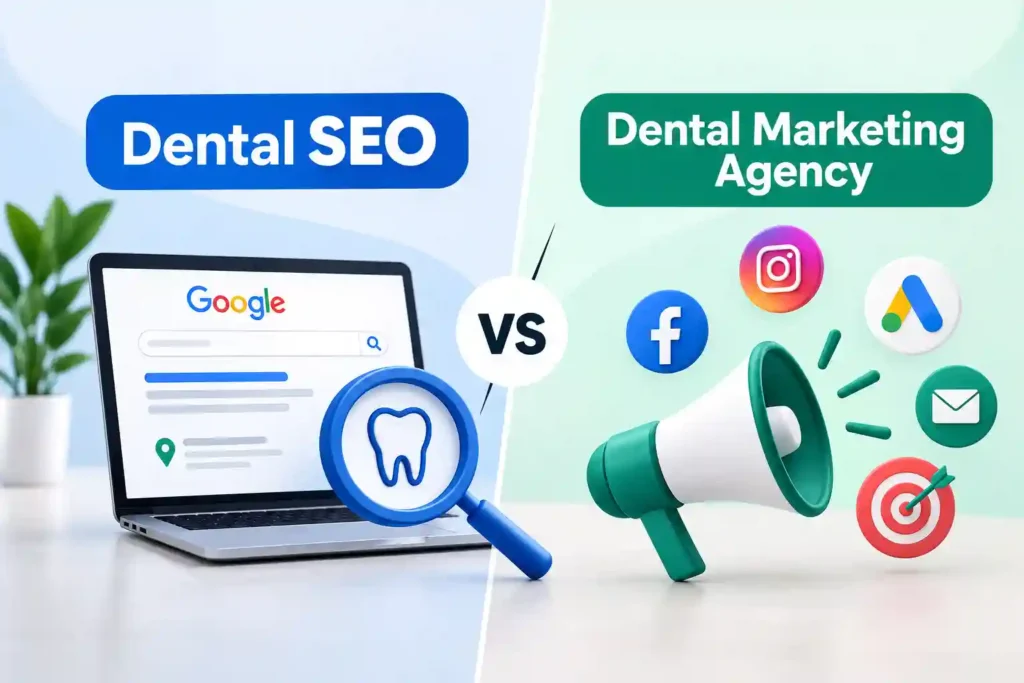
The dental SEO vs dental marketing question comes down to scope. A dental SEO agency works on one channel making your practice visible in search results, the map pack, and now AI answers. A dental marketing agency works across every channel a patient might come through: search, paid ads, social, email, referrals, and the patient experience once they arrive.
SEO is a subset of marketing. The confusion exists because many agencies use the terms interchangeably while selling very different amounts of work.
Dental SEO vs dental marketing: the short answer
Dental SEO agency: owns organic visibility. Technical fixes, Google Business Profile, service pages, reviews, local citations, links, and search reporting.
Dental marketing agency: owns patient acquisition overall. Everything above plus paid ads, social content, brand positioning, email and recall campaigns, print or direct mail, and sometimes front-desk training.
One channel, done deeply, versus several channels, coordinated. Neither is better in the abstract the right choice depends on what’s currently broken at your practice.
What a dental SEO agency does
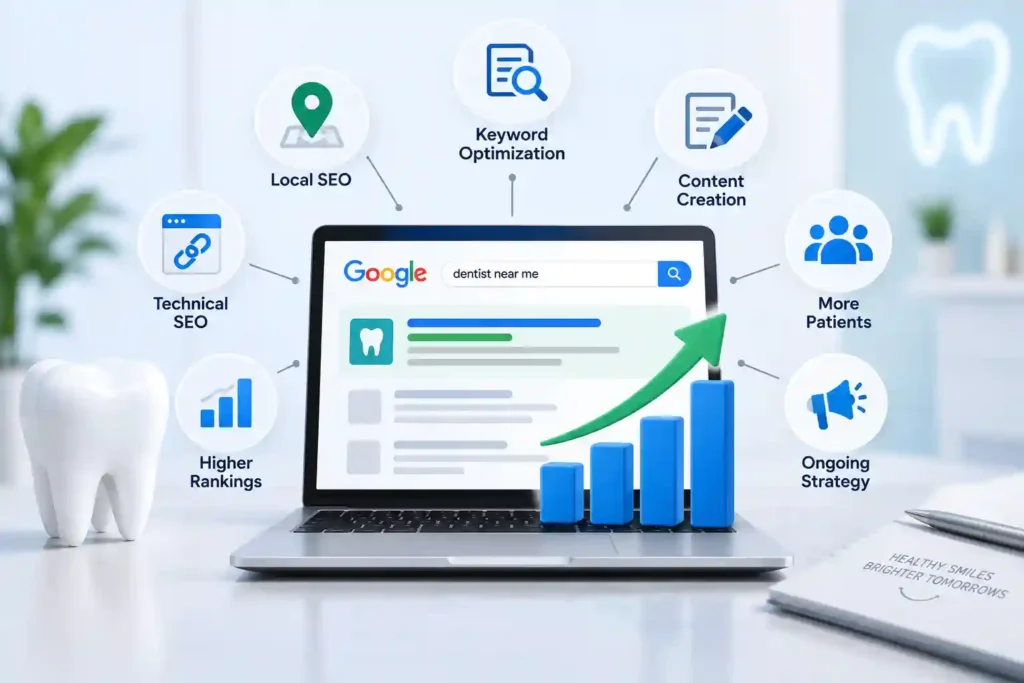
It makes you the result patients find when they search. The work divides into on-site (speed, schema, service pages, content) and off-site (Google Business Profile, reviews, citations, local links). The detailed breakdown sits in what a dental office SEO agency does.
Results compound and arrive slowly. Expect map pack movement in six to eight weeks and competitive procedure rankings in six to nine months. Once earned, those positions keep producing without the same monthly spend.
The trade-off: SEO can’t create demand on a schedule. If you need chairs filled next month, it’s the wrong tool.
What a dental marketing agency does
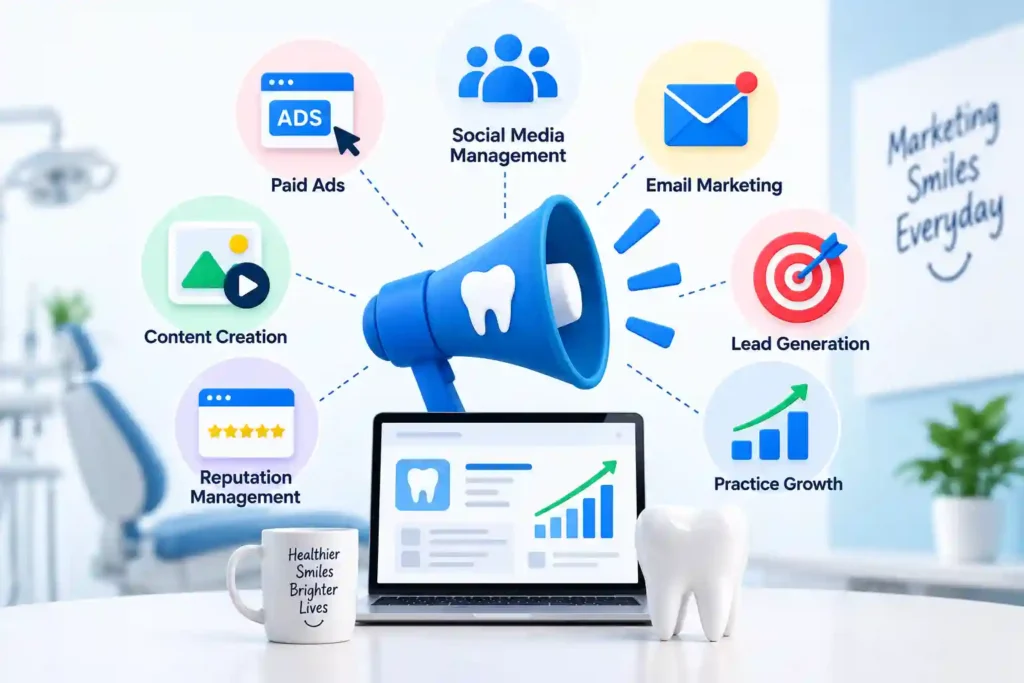
It builds demand across channels and controls the mix. Paid search and Meta ads for immediate volume, SEO for long-term cost per patient, social for recognition, email and recall for the patients you already have.
A good one also looks at what happens after the enquiry missed calls, slow form replies, a treatment coordinator who doesn’t follow up. Those cost more patients than any ranking position, which is why the conversion side belongs in scope.
The trade-off: broader scope at the same budget means less depth everywhere. A £2,000 retainer split across five channels does little in any of them.
Dental SEO vs dental marketing at a glance
| Dental SEO agency | Dental marketing agency | |
|---|---|---|
| Scope | Organic search only | All acquisition channels |
| Speed of results | 3–9 months | Days, with paid ads |
| Cost over time | Falls as rankings hold | Stays flat or rises with ad spend |
| Best for | Established practices building compounding visibility | New or relocating practices needing patients now |
| Main risk | Too slow if chairs are empty | Budget spread too thin to work anywhere |
| Reporting | Rankings, map pack, organic enquiries | Cost per patient across every channel |
Which does your practice need right now?
The dental SEO vs dental marketing decision gets easier once you name the constraint.
You need SEO first if: you have steady patient flow but want to lower your cost per acquisition, you’re outranked locally by practices no better than yours, or you’re paying for ads on searches you should own organically.
You need broader marketing first if: you’ve just opened, just moved, or you need patients within weeks rather than months. Paid ads buy time while SEO is built underneath.
You need neither yet if: you’re booked out six weeks. Fix scheduling and hygiene capacity before buying more demand. The framework for deciding this is covered in how to choose the best dental SEO agency.
Where the two overlap and where you pay twice
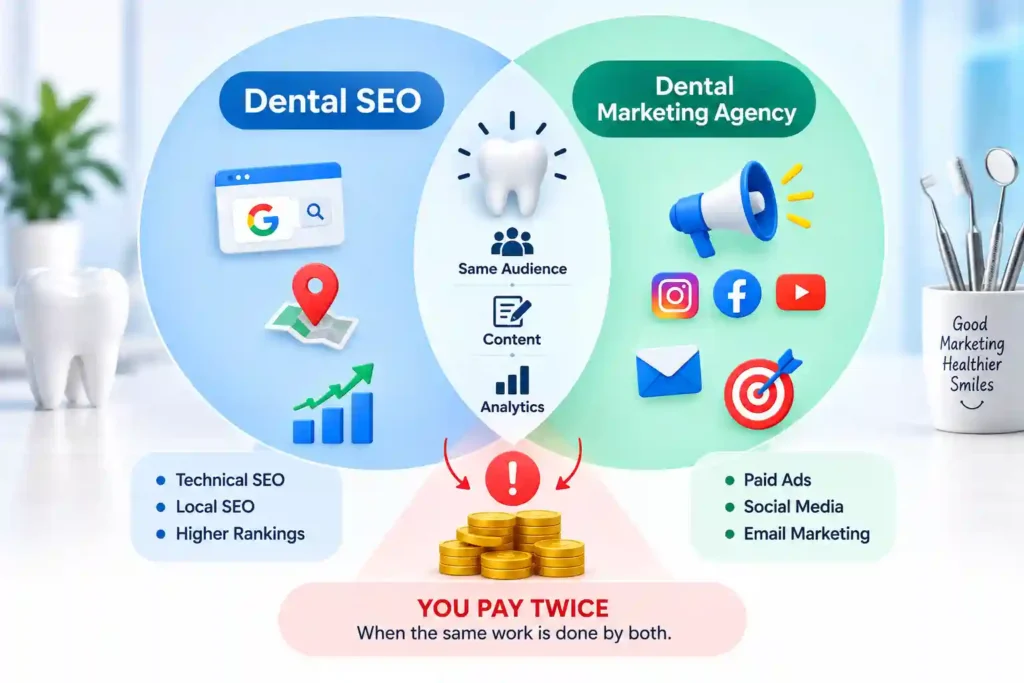
In practice, the dental SEO vs dental marketing split is never clean. Several items sit in both scopes, and practices running two agencies often fund them twice: content, landing pages, reviews, analytics, and call tracking.
The common waste is paid search bidding on your own practice name while SEO already owns that result, or an ads agency building landing pages that duplicate existing service pages and split their ranking strength. If you run both, insist the two talk monthly and agree who owns which pages a point worth raising during the free audit stage before anyone starts work.
Can one agency do both?
Yes, and for most single-location practices that’s the simpler setup. What matters is whether one agency genuinely resources both a strategist and writer for search, plus someone managing ad spend daily or whether one generalist is stretched across everything.
The hybrid model has a name and a scope of its own, laid out in what a dental SEO marketing agency actually does. Ask who runs ads day to day and who writes clinical content. If it’s the same person, you’ve found the limit.
FAQs
Is dental SEO part of dental marketing?
Yes. SEO is one channel inside marketing, alongside paid ads, social, email, and referrals. Every dental marketing agency should cover SEO; not every dental SEO agency covers marketing.
Which costs more, dental SEO or dental marketing?
SEO retainers usually run $1,000 to $3,000 a month for a single location. Broader marketing costs more because ad spend sits on top of the fee. Over two to three years, SEO tends to deliver the lower cost per patient.
Do I still need SEO if I’m running Google Ads?
Yes. Ads stop producing the day you stop paying, and they cost more per patient in competitive dental markets. Most practices use ads for immediate volume and SEO to reduce dependence on them over time.
How long before SEO beats paid ads on cost?
Typically 9 to 18 months, depending on market competition and your starting position. After that point, organic patients cost a fraction of paid ones because the visibility is already earned.
Should a new practice start with SEO or marketing?
Both, in sequence. Run ads for immediate patients while SEO foundations — profile, service pages, reviews — are built in the background. Starting SEO alone means months with no new patients.
What’s the difference between dental SEO and local SEO?
Local SEO is the part of dental SEO focused on the map pack: your Google Business Profile, reviews, citations, and proximity signals. For most practices it produces more calls than the website does, which is why specialists prioritise it see our dental SEO services for how both sides are handled.
Choosing between them
The dental SEO vs dental marketing choice should follow one question: what’s actually limiting your growth? If patients can’t find you, that’s an SEO problem. If they find you and don’t call, that’s a conversion problem. If nobody in your area knows you exist yet, that’s a broader marketing problem — and buying the wrong one of the three is how practices spend a year on the thing that wasn’t broken. A specialist will tell you which it is before quoting, which is the argument behind working with a dental-only agency.