
Every agency calls itself an expert. The word costs nothing to put on a homepage. What actually separates an expert dental SEO agency from a competent generalist is narrower than most practice owners expect, and it has almost nothing to do with the tools they use or the size of their team.
It comes down to three things: whether they understand the economics of your chair, whether they know how patients search for specific procedures, and whether they can prove the difference they made. Everything below is a way of testing those three.
Start with the maths, not the proposal
Before comparing agencies, work out your own break-even. Take the average lifetime value of a new patient at your practice for a general practice that’s often $1,500 to $3,000 once you account for recall visits, and considerably higher for implant or ortho cases. Divide the monthly retainer by that number. That’s how many new patients a month the agency needs to produce before it has cost you nothing.
For most practices the answer lands between one and three patients. That reframes the whole conversation. A $2,500 retainer isn’t expensive if it reliably produces four patients a month; a $600 retainer is expensive if it produces none. An agency worth hiring will do this calculation with you on the first call instead of avoiding it, and it’s the frame we use across our dental SEO services.
The second half of the maths is time. SEO compounds a service page that ranks in month seven keeps producing in year two with no additional spend, which is why the honest comparison isn’t against a month of Google Ads but against a year of it.
Expertise shows up in how they segment procedures
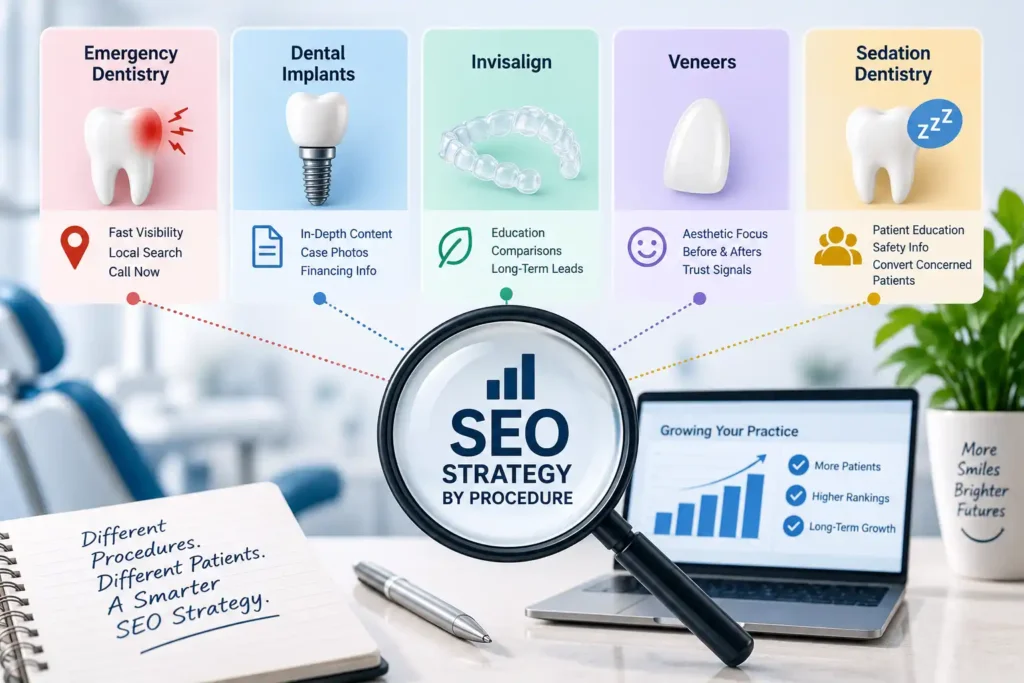
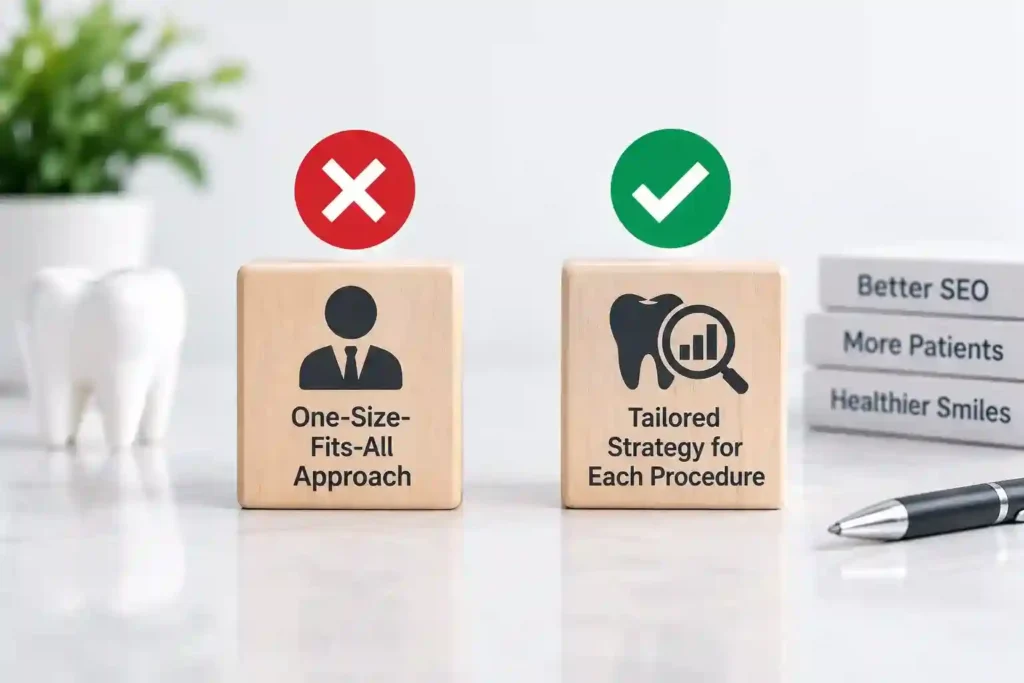
This is the clearest test. Ask any agency how they’d approach implants versus emergency dentistry. If they describe the same plan for both, they aren’t experts.
Emergency searches are immediate, mobile, and decided in the map pack. The work is Google Business Profile completeness, review velocity, hours accuracy, and a page that loads in under two seconds with a tap-to-call button above the fold. Content barely matters.
Implants are the opposite. Patients research for weeks, compare financing, read about bone grafting and recovery, and often visit three practices. The work is a deep content cluster, real case photography, pricing transparency, and trust signals and none of it converts on the first visit. An expert agency plans for that gap; an average one wonders why the implant page “isn’t converting” in month two.
Invisalign, veneers, and sedation each have their own pattern again. If you want the fuller breakdown of how to interrogate an agency’s process, our guide on choosing an SEO agency for your dental practice covers the questions to put to them directly.
Average agency vs expert agency
| Area | Average agency | Expert dental agency |
|---|---|---|
| Keywords | Volume-based lists | Mapped to procedures and margin |
| Reporting | Rankings and traffic | Booked consults and call recordings |
| Content | Monthly blog quota | Service pages first, blogs to support |
| Local | Citations submitted once | Profile managed weekly, reviews tracked |
| Links | Directories and guest posts | Local sponsorships, dental press, real placements |
| Escalation | Waits for your email | Flags a ranking drop before you notice |
The right-hand column costs more to deliver, which is why genuinely expert agencies rarely compete at the bottom of the market. Our own tiers and what sits inside each are listed on the pricing page.
They treat the phone call as part of SEO
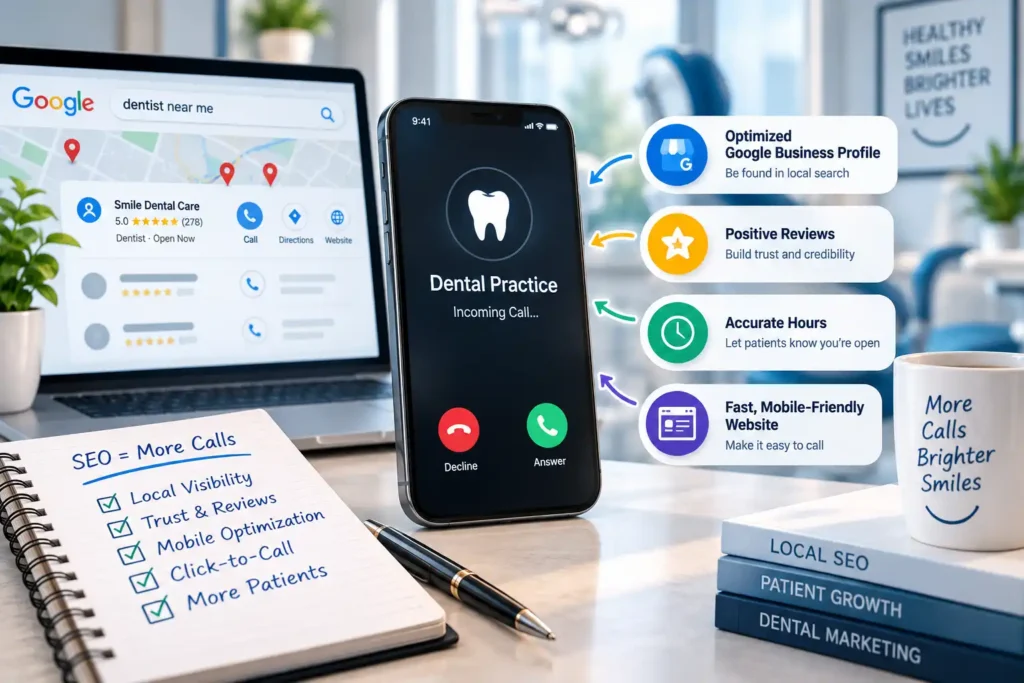
Here’s where most practices lose money that has nothing to do with Google. An agency can deliver forty extra calls a month and the practice still won’t grow, because the front desk is with a patient, the call goes to voicemail, and the caller dials the next practice on the list.
An expert agency listens to call recordings. They’ll tell you your missed-call rate, how many callers asked about price and were told to come in for a consult, and how many booked. Some of the biggest wins in dental marketing come from fixing the twenty seconds after the phone rings, not from moving from position four to position two.
This is also the honest test of whether an agency is measuring anything real. If they can’t tell you what happened on the calls they generated, their reporting is a rankings screenshot with extra steps.
They know your market’s ceiling
There are postcodes where four established practices have held the map pack for a decade, with hundreds of reviews each. An expert agency will tell you that before taking your money, and will propose a different route service-specific pages, a satellite location strategy, or a focus on suburbs where you’re the closest option rather than the fifth.
That kind of candour is the most reliable signal of expertise you’ll get in a sales call, because it costs the agency the sale. Sound local SEO work starts with an honest read of the radius you can realistically win.
When an expert agency isn’t worth hiring
Worth saying plainly. If your website is five years old, slow, and doesn’t convert, SEO spend leaks out the bottom fix the site first. If you’re at capacity and turning patients away, more enquiries don’t help; scheduling and hygiene capacity do. And if you can’t commit for at least six months, the money is better kept, because SEO stopped at month three returns nothing at all.
An agency that takes the retainer anyway in all three of those cases has told you what they are.
Testing the claim in 90 days
You don’t have to take expertise on faith. Agree three checkpoints before you sign:
By day 30 you should have a documented baseline, a tracking setup you can log into yourself, a technical fix list with items already shipped, and a Google Business Profile that’s been visibly worked on.
By day 60 you should see movement in map pack impressions and early ranking shifts on lower-competition terms, plus the first content live rather than “in review.”
By day 90 you should be able to count enquiries attributed to organic search and compare them to your baseline. The number doesn’t have to be big yet. It has to exist.
If those three checkpoints are met, you have an agency worth keeping. If they’re not, you’ve learned it in a quarter instead of a year. That’s the whole point of setting them up front and it’s what we agree with practices before any work starts, which you can walk through on a free strategy call.
Bottom line
A dental SEO expert agency is worth hiring when it can explain your break-even, treat each procedure as its own search problem, tell you what happened on the phone, and be honest about what your market allows. Anything short of that is a vendor, and vendors are easy to replace.